
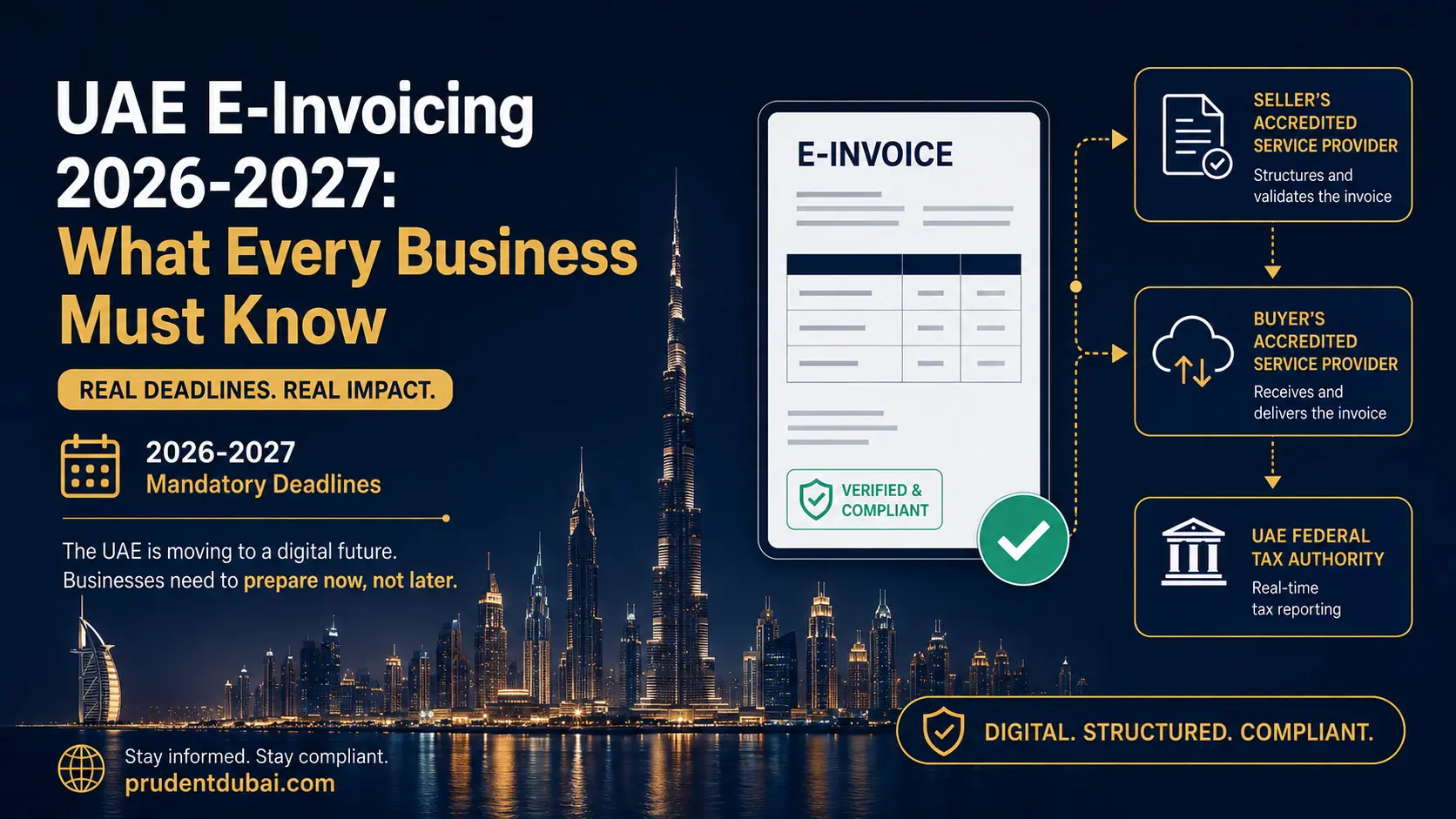
If your business operates in the UAE, mandatory e-invoicing is no longer a distant regulation on the horizon; it is a live system with real deadlines, and the first of them lands before the end of this year.
On 1 June 2026, the Ministry of Finance (MoF) released Version 1.1 of the UAE Electronic Invoicing Guidelines, refining the rules just weeks before the national pilot phase opened on 1 July 2026.
Whether you run a mainland company, a free zone entity, or an offshore structure, here is everything you need to know and exactly what to do next.
What Is UAE E-Invoicing?
E-invoicing replaces PDF and paper tax invoices with structured, machine-readable invoices generated in XML format (following the PINT-AE or UBL standard). Instead of emailing a PDF to a customer, invoices are exchanged through a decentralized network and reported to the Federal Tax Authority (FTA) in near real time.
The UAE has adopted the Peppol 5-corner model, a globally recognized framework already used across parts of Europe and Asia-Pacific. You can follow official updates directly on the Ministry of Finance’s e-invoicing portal, the primary source for this rollout. In this model, both the seller and the buyer connect through their own Accredited Service Provider (ASP), an MoF-approved intermediary that handles secure exchange and reporting to the FTA.
This is part of the UAE’s wider ‘We the UAE 2031’ digital transformation strategy, designed to reduce paperwork, close the VAT compliance gap, and modernize tax administration.
How Does the E-Invoicing Process Actually Work?
Understanding the model is one thing, seeing what actually happens to a single invoice is another. Here’s the real sequence, start to finish:
- Issue – The seller generates the invoice as structured XML data (PINT-AE or UBL format) through their own ASP, not as a PDF.
- Validate – The seller’s ASP checks the invoice against the required data fields and format before it’s allowed to move forward.
- Exchange – The seller’s ASP transmits the invoice securely to the buyer’s ASP via the Peppol network, this is the “5-corner” handoff.
- Receive – The buyer’s ASP delivers the structured invoice into the buyer’s own accounting or business software.
- Report – Both the seller’s and buyer’s ASPs independently report the transaction data to the FTA in near real time.
If an error is found after an invoice has already been issued, it can’t simply be edited, a credit note must be issued instead, and under Ministerial Decision No. 243 of 2025, both invoices and credit notes must be issued within 14 days of the business transaction, or within the timeline set by the VAT Law, whichever is earlier.
Who Is in Scope?
Electronic invoicing will be mandatory for all persons conducting business in the UAE, regardless of VAT registration status, unless specifically excluded. This is broader than VAT alone; it captures many entities that assumed they were outside the tax net.
A few points business owners consistently get wrong:
- Free zones are not exempt. DMCC, JAFZA, IFZA, RAKEZ, ADGM, and DIFC entities are all in scope, there is no blanket free zone carve-out.
- Government entities acting in a sovereign, non-commercial capacity are excluded, mirroring the existing VAT Law treatment.
- International air transport of goods where an airway bill is issued has a temporary 24-month exclusion.
- Certain exempt financial services (as defined under VAT Executive Regulations) fall outside the scope, with specific treatment where those services are exported to non-residents.
- B2C transactions are currently out of scope of the mandate; the initial focus is strictly B2B and B2G—though this may change in a later phase.
This is broader than VAT alone; it captures many entities that assumed they were outside the tax net. If you’re still confirming your own VAT position first, our UAE VAT Registration guide covers who needs to register and when.
The UAE E-Invoicing Timeline
The rollout is phased by annual revenue (measured as gross income for the most recent accounting period per your financial statements) and by entity type:
| Business Category | Appoint ASP by |
Mandatory Go-Live |
|
Voluntary / Pilot (any business) |
— | From 1 July 2026 |
|
Revenue ≥ AED 50 million |
30 October 2026 |
1 January 2027 |
|
Revenue < AED 50 million |
31 March 2027 |
1 July 2027 |
| Government entities | 31 March 2027 |
1 October 2027 |
Source: UAE Electronic Invoicing Guidelines v1.1 (MoF, 1 June 2026); Ministerial Decisions No. 243 & 244 of 2025; Cabinet Decision No. 106 of 2025.
Note the ASP deadline for large businesses was extended once already, originally 31 July 2026, now pushed to 30 October 2026, but the mandatory go-live date of 1 January 2027 has not moved.
Businesses close to the AED 50 million threshold should not assume they have until 2027 to act; fast growth or new contracts can pull a business into the earlier phase sooner than expected.
What’s New in Version 1.1 (June 2026)?
Version 1.1 does not change the core framework—the transaction scope, the Peppol 5-corner model, the PINT-AE technical specification, and the ASP requirement all remain exactly as originally legislated. What it adds is practical clarity in two new appendices that businesses had been asking for:
- Appendix 4 – Record-keeping and storage: expands on retention obligations under Article 11 of Ministerial Decision No. 243 of 2025. Businesses remain legally responsible for retaining e-invoices, credit notes, and related tax data for the statutory retention period and must produce them to the FTA on request. Offshore and cloud-based data storage is now explicitly permitted, provided access requirements are met.
- Appendix 5 – Advance payments and retention billing: clarifies how to treat deposits, progress billing, and contractual retentions, a common pain point in construction and real estate. Linking an advance invoice to its final invoice is now mandatory: the advance amount is entered in the ‘Paid Amount’ field, and the advance invoice is cited in the ‘Preceding Invoice Reference’ field.
- A 24-month grace period has been introduced for intra-group UAE VAT transactions, giving corporate groups more runway to align internal invoicing before full enforcement.
What Counts as a Valid E-Invoice?
A PDF tax invoice, however well formatted, is not a valid e-invoice under the new regime and will not be recognized by the FTA once the mandate applies to you. A valid e-invoice must be structured data (XML, using UBL or PINT-AE), issued and received via an accredited service provider; and reported to the FTA’s e-Billing system.
Your Tax Identification Number (TIN), the first 10 digits of your TRN becomes your Participant Identifier in the network, even for entities within a VAT Tax Group, where each member uses its own TIN rather than the group representative’s.
What Counts as a System Failure, and How Long Do You Have to Report It
Under Ministerial Decision No. 243 of 2025, a System Failure is officially defined as any technical malfunction, disruption, or unavailability of the Electronic Invoicing System that prevents the Issuer or Recipient from meeting their obligations under the Decision.
If one occurs, both the Issuer and the Recipient must notify the FTA within 2 business days of the failure happening, this is the exact window the AED 1,000-per-day penalty in the table below is built around. Once the system is restored, outstanding invoices must still be transmitted to remain compliant.
Separately, if any of your registered ASP data changes (such as company details affecting your e-invoicing setup), you have 5 business days to notify your ASP.
Penalties for Non-Compliance
Cabinet Decision No. 106 of 2025 sets out administrative penalties for e-invoicing violations, separate from existing VAT and Tax Procedures penalties. Missing your ASP appointment deadline or your mandatory go-live date carries a penalty of AED 5,000 per month for each month of non-compliance.
On the upside, penalties do not apply to voluntary invoices issued before your mandatory date — the pilot phase is a genuinely low-risk way to test your systems early.
Enforcement of penalties for e-invoicing violations
Administrative penalties specified in a table annexed to CD No. 106, as presented below, will be imposed for noncompliance with the e-invoicing provisions.
|
No. |
Description of violation |
Administrative penalty amount |
|
1 |
Non-implementation of e-invoicing and failure to appoint an Accredited Service Provider (ASP) within the timeline |
AED 5,000 for each month or part of a month delayed |
|
2 |
Failure to issue and send electronic invoices |
AED 100 per invoice, capped at AED 5,000 per calendar month |
|
3 |
Failure to issue and send electronic credit notes |
AED 100 per invoice, capped at AED 5,000 per calendar month |
|
4 |
Failure to inform the FTA of a System Failure (Issuer) |
AED 1,000 for each day of delay or part thereof |
|
5 |
Failure to inform the Authority of a System Failure (Recipient) |
AED 1,000 for each day of delay or part thereof |
|
6 |
Failure to update the ASP on data changes (Issuer and Recipient) |
AED 1,000 for each day of delay or part thereof |
Key E-Invoicing Terms, Quickly Defined
ASP (Accredited Service Provider):
An MoF-approved intermediary that handles the secure exchange and FTA reporting of your e-invoices on your behalf.
Peppol 5-corner model:
The exchange framework the UAE has adopted, where both the seller and buyer connect through their own separate ASP rather than a single shared system.
PINT-AE / UBL:
The two accepted structured data formats an e-invoice must be issued in, neither is a PDF or scanned document.
TIN (Tax Identification Number):
The first 10 digits of your TRN, used as your unique Participant Identifier within the e-invoicing network.
System Failure:
Any technical malfunction, disruption, or unavailability of the e-invoicing system that stops you from meeting your obligations, must be reported to the FTA within 2 business days.
Five Steps to Prepare Now
- Confirm your phase. Map your entity’s most recent annual revenue against the AED 50 million threshold to know your ASP and go-live deadlines.
- Select and contract an Accredited Service Provider. Choose one listed on the MoF/FTA accreditation register and confirm it supports PINT-AE/UBL and Peppol connectivity.
- Review advance payment and retention workflows. Construction, real estate and project-based businesses should map current billing practices against Appendix 5 now.
- Join the voluntary pilot. Testing before your mandatory date lets you find integration gaps without penalty exposure.
- Align your VAT and corporate tax records. E-invoicing data will increasingly intersect with FTA VAT and Corporate Tax reporting; your accounting, VAT filing, and e-invoicing workflows need to speak to each other.
How PrudentDubai.com Can Help
Between company formation, VAT registration, corporate tax compliance and accounting, e-invoicing touches almost everything PrudentDubai.com already manages for clients.
We help you confirm which phase applies to your business, prepare your invoicing and accounting workflows for ASP integration, and keep your VAT and corporate tax filings aligned as the framework rolls out. Book a free consultation to get your e-invoicing readiness assessment started.