
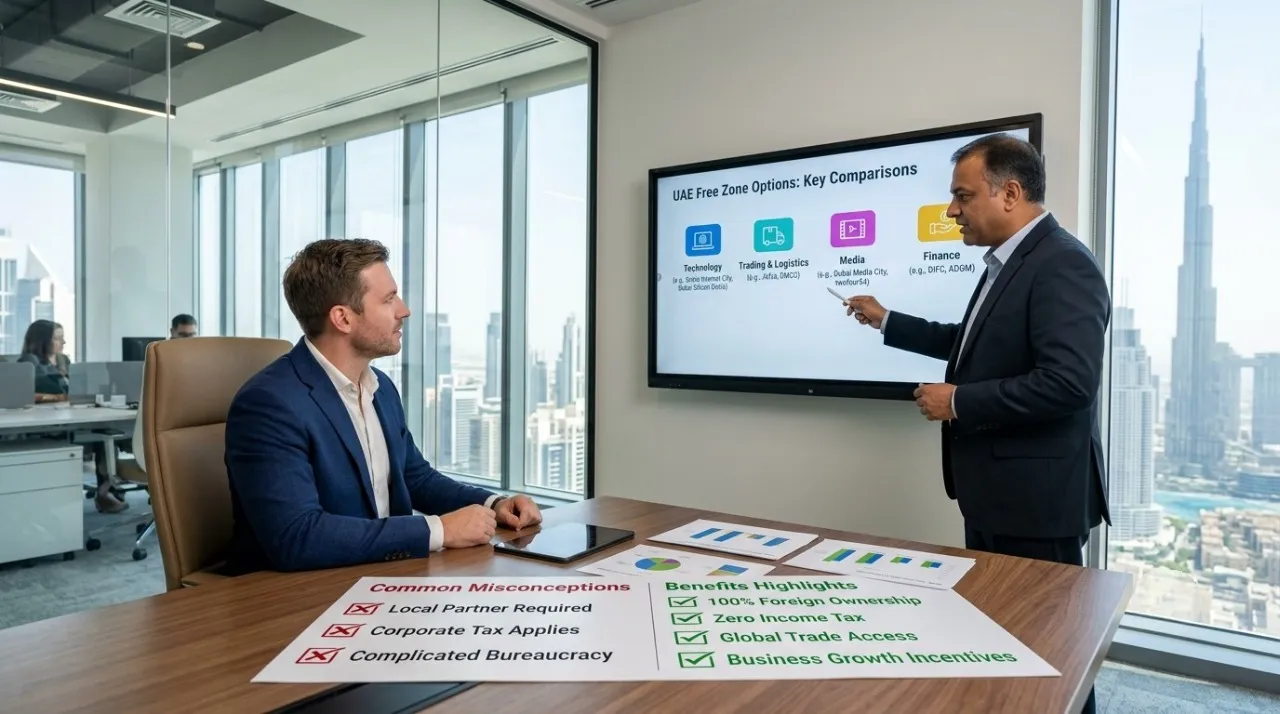
Free zone company setup in Dubai has become one of the most popular routes for entrepreneurs and investors looking to establish a presence in the UAE. The appeal is easy to understand full foreign ownership, fast registration, and access to some of the world’s most active trade corridors. But as free zones have grown in popularity, so has the volume of outdated or simply incorrect information circulating about how they work.
Many business owners make critical setup decisions based on assumptions rather than facts choosing the wrong free zone, underestimating compliance obligations, or believing their company will be restricted in ways that no longer apply. These misunderstandings can lead to wasted time, unnecessary costs, and licensing structures that don’t match the business’s real goals.
This guide breaks down the most common misconceptions about free zone companies in the UAE, replacing assumption with clarity so you can make an informed decision about your business setup.
Why Free Zone Companies Are So Popular in the UAE
Free zones were created to diversify the UAE’s economy beyond oil, and today the country is home to more than 40 of them, many built around specific industries such as technology, media, healthcare, or logistics. Their popularity isn’t accidental a handful of structural advantages make them genuinely attractive to a wide range of business owners:
- 100% foreign ownership, with no requirement for a local Emirati sponsor or partner
- Full repatriation of profits and capital back to the owner’s home country
- Competitive tax treatment, including exemptions for many qualifying free zone activities
- A streamlined, largely digital registration process that moves quickly once documents are ready
- Direct access to global trade routes through world-class ports, airports, and logistics networks
These benefits explain why free zones appeal to such different types of business owners. Startups are drawn to the lower entry costs and fast turnaround; SMEs value the operational flexibility and room to scale; and international investors appreciate the regulatory familiarity that free zone jurisdictions are known for.
Misconception #1: Free Zone Companies Cannot Do Business in the UAE
One of the oldest myths about free zone companies is that they’re confined to operating outside the UAE altogether. Free zone companies can engage with the broader UAE market the nuance lies in how they do it.
A free zone license generally permits a company to operate within its free zone and internationally without restriction. Selling directly into the UAE mainland, however, typically requires either appointing a local distributor or service agent, or obtaining a dual license that adds mainland reach without giving up free zone status. Many free zones now offer this kind of dual-licensing arrangement specifically to bridge that gap.
This distinction trips up many first-time entrepreneurs, who either assume free zone companies are barred from the mainland entirely, or assume the opposite that no extra steps are needed. Understanding the operational scope of your specific license, and the activities permitted under it, is essential before assuming what your company can or cannot do.
Misconception #2: All Free Zones Offer the Same Benefits
It’s tempting to think of “free zone” as a single, interchangeable category, but the differences between individual free zones can be significant. Each one is governed by its own regulatory authority, which sets its own rules around permitted business activities, licensing categories, minimum capital requirements, and visa allocations.
Some free zones are built around a specific sector media, technology, healthcare, or commodities trading and offer infrastructure and licensing tailored to that industry. Others operate as broad, multi-sector hubs with wider activity lists. The right choice depends entirely on what the business does and where its customers and suppliers are based. A few well-known examples illustrate how differently free zones are positioned:
| Free Zone | Known For | Typical Activities | Good Fit For |
|---|---|---|---|
| DMCC | Trade & commodities hub | Trading, commodities, fintech | Trading companies, brokers |
| DIFC | Financial services centre | Banking, asset management, fintech | Regulated financial firms |
| Dubai Internet City | Technology ecosystem | IT, software, digital services | Tech startups, SaaS companies |
| Dubai Media City | Media & creative hub | Broadcasting, marketing, production | Media and creative agencies |
| JAFZA | Logistics & industrial hub | Manufacturing, logistics, trading | Import/export, industrial firms |
| RAKEZ | Cost-effective setup | General trading, consulting, services | Startups, budget-conscious SMEs |
This table is illustrative rather than exhaustive exact activity lists, fees, and requirements should always be confirmed with the relevant free zone authority, since they’re updated from time to time.
Misconception #3: Free Zone Company Setup Is Always Expensive
Cost is one of the most common reasons entrepreneurs hesitate before pursuing a free zone setup, often based on outdated figures or pricing that applies to a different free zone altogether. In practice, Dubai free zone company setup cost varies enormously depending on the free zone chosen, the business activity, and how many visas the company needs.
Several free zones, particularly those built for SMEs and startups, offer entry-level packages that bundle the trade license with a flexi-desk or shared office space, keeping the upfront investment relatively low. Larger or more specialised free zones those tied to financial services or industrial activity naturally carry higher costs because of the infrastructure, regulatory rigor, or premium office requirements involved.
It also helps to separate one-time setup costs from costs you’ll see every year, such as visa renewals, office or warehouse rent, license renewal fees, and document attestation. Looking at the full picture, rather than the headline license fee alone, gives a far more realistic sense of what free zone setup costs.
Misconception #4: Free Zone Registration Is Complicated
Many entrepreneurs’ picture free zone registration as a maze of paperwork and government office visits. That reputation hasn’t kept pace with reality. Most free zones in the UAE now run their applications through digital portals, allowing applicants to reserve a trade name, select a business activity, and upload documents online rather than in person.
Some activities still require additional external approvals financial services, healthcare, education, and media broadcasting are common examples which adds extra review steps to the process. None of this is roadblock-level complex, but it does benefit from a clear sequence and complete documentation from the outset. This is exactly where professional assistance reduces friction: experienced consultants know which approvals apply to a given activity, the order steps need to happen in, and how to avoid the delays caused by incomplete submissions when you register company in Dubai free zone jurisdictions.
Misconception #5: Free Zone Companies Are Only Suitable for Large Businesses
Free zones are sometimes seen as something only large corporations bother with, but the opposite is closer to the truth. A large share of free zone clientele are solo founders, freelancers, and small teams. Many zones offer freelancer permits and single-shareholder licenses designed specifically for individuals offering services, alongside flexible office solutions like flexi-desks and shared workspace that remove the need for a costly physical lease.
Free zones also support gradual scaling. A company can begin with a freelancer permit or single-activity license, add visas as headcount grows, and later upgrade its license category or move into dedicated office space all without restarting the business from zero.
Misconception #6: You Don’t Need to Think About Compliance
Because free zone setup is marketed as fast and simple, some business owners assume the obligations stop once the license is issued. That’s not accurate. Free zone companies still need to renew their trade license annually, maintain accurate financial and corporate records, and meet UAE-wide regulatory requirements such as economic substance regulations, anti-money laundering rules where applicable, and VAT registration once turnover thresholds are met.
Missing a renewal deadline or failing a compliance obligation can lead to fines, license suspension, or complications when applying for visas or opening bank accounts. Treating compliance as an ongoing responsibility, rather than a one-time hurdle cleared at setup, protects the business and keeps it in good standing with both the free zone authority and UAE federal regulators.
Misconception #7: The Cheapest Setup Option Is Always the Best Choice
Low-cost packages are appealing, but the cheapest license isn’t automatically the right one. Entry-level packages sometimes come with limitations that aren’t obvious upfront a restricted number of visa allocations, a narrow list of permitted activities, or shared office space that doesn’t meet the requirements of certain banks or clients.
Before choosing based on price alone, it’s worth asking whether the package supports the number of employees the business expects to hire, the activities it actually intends to carry out, and the kind of office presence its clients or banking partners expect to see. A slightly higher upfront cost that avoids a license upgrade six months later is often the more economical choice in the long run.
What Actually Affects Dubai Free Zone Company Setup Cost?
Rather than a single number, free zone setup cost is the sum of several variables that shift depending on the business. Five factors tend to have the biggest impact on the final figure:
| Cost Factor | Why It Matters |
|---|---|
| Business activity | Some activities require extra regulatory approvals, higher capital requirements, or specialised licensing, all of which raise the overall cost. |
| Number of visas | Each visa carries its own government fee, medical test, and Emirates ID cost, making visa count one of the biggest drivers of total cost. |
| Office or workspace type | A shared flexi-desk costs far less than a dedicated office or warehouse, and some license categories require a minimum office size. |
| Free zone selection | Each free zone sets its own registration, licensing, and renewal fees, so identical businesses can face different costs depending on location. |
| Government and admin fees | Trade name reservation, initial approval, attestation, and other administrative charges add to the total beyond the headline license fee. |
Because these variables interact, the most reliable way to get an accurate Dubai free zone company setup cost figure is to share your specific business activity and visa requirements with the chosen free zone or a setup consultant, rather than relying on a generic published rate.
Key Considerations Before Choosing a Free Zone
Before settling on a free zone, it helps to step back and assess the bigger picture rather than comparing license prices alone:
- Business objectives are the goal to serve UAE clients, trade internationally, or both?
- Target market does the free zone’s industry focus and reputation align with where customers and partners are based?
- Operational requirements do the business need warehouse space, specific equipment, or certifications?
- Future expansion plans do the free zone allow upgrading license categories, adding visas, or moving into larger premises as the business grows?
- Banking and visa considerations does the free zone have a track record of clients successfully opening corporate bank accounts, and does its visa allocation match the team’s growth plans?
Working through these considerations before applying helps prevent a costly mismatch between the free zone chosen and what the business actually needs further down the line.
Why Professional Support Makes Freezone Company Setup UAE Easier
Free zone setup doesn’t require professional help, but for most entrepreneurs it removes a significant layer of guesswork. A good freezone company setup UAE consultant brings comparative knowledge of dozens of free zones, business activities, and licensing categories knowledge that’s difficult to build from scratch while also trying to run a business.
Beyond simply choosing a free zone, professional support typically covers preparing and reviewing documentation before submission, structuring the licensing and visa package to match the budget, and liaising directly with free zone authorities to keep approvals moving. The result is usually a faster, smoother process, with fewer rejected applications and fewer surprises in the final cost.
How to Successfully Complete Company Setup in Dubai Free Zone
With the misconceptions cleared up, the practical path to company setup in Dubai free zone jurisdictions follows a consistent sequence:
- Plan the business structure decide on the legal form (FZE, FZC, branch, or freelancer permit), shareholding, and the specific activities the license needs to cover.
- Select the appropriate free zone match the free zone’s industry focus, cost structure, and visa allocation to the business plan.
- Prepare documentation passport copies, a business plan, proof of address, and any activity-specific approvals the free zone requires.
- Obtain licenses and approvals submit the application, secure initial approval, and finalise the trade license once any external regulator signoffs are in place.
- Open a corporate bank account provide the license and shareholder documents to the chosen bank and allow time for their due diligence process.
- Maintain compliance after incorporation renew the license annually, keep financial records current, and meet ongoing obligations such as VAT registration where applicable.
Following this sequence reduces back-and-forth with authorities and keeps the business positioned to operate without interruption from day one.
Frequently Asked Questions About Free Zone Company Setup
Can a Free Zone company do business across the UAE?
Yes, with the right arrangement. A free zone company can trade internationally and within its free zone without restriction and can reach UAE mainland clients through a local distributor, a service agent, or a dual license, depending on the activity and free zone.
How much is the average Dubai free zone company setup cost?
There isn’t a single average, because cost depends heavily on the free zone, business activity, office type, and number of visas needed. The most reliable figure comes from requesting a quote based on your specific business activity and visa requirements rather than relying on a generic published rate.
How long does it take to register a company in Dubai Free Zone?
Straightforward applications with standard activities and complete documentation are often approved within a few business days to a couple of weeks. Activities requiring additional regulatory approval, such as financial services or healthcare, typically take longer.
Which Free Zone is best for startups?
It depends on the startup’s industry and budget, but many startups gravitate toward free zones known for lower-cost packages, flexible office solutions, and activity lists that fit their business model often in technology, media, or general trading categories.
What are the benefits of freezone company setup UAE entrepreneurs prefer?
The most commonly cited benefits are full foreign ownership, full profit repatriation, competitive tax treatment, fast digital registration, and access to global trade infrastructure, combined with the flexibility to start small and scale over time.
Is Free Zone company setup suitable for foreign investors?
Yes. Free zones were specifically designed to attract foreign investment, offering 100% foreign ownership without requiring a local partner, alongside investor-friendly regulations and straightforward repatriation of profits
Making the Right Free Zone Decision for Long-Term Business Success
The misconceptions covered here share a common thread: free zone companies are often judged by outdated assumptions rather than how the system works today. Free zone companies can engage with the UAE mainland under the right arrangement, free zones differ significantly from one another, setup costs scale with real business needs rather than being uniformly high, registration has become largely digital, and free zones serve everyone from solo freelancers to established multinationals.
Replacing assumption with evaluated fact at each of these points leads to a free zone structure that fits the business, rather than one chosen on price or rumour alone. Combined with attention to ongoing compliance, the right free zone decision sets a business up for sustainable growth instead of a costly restructuring later.
If you’re ready to move past the misconceptions and find out which free zone genuinely fits your business goals, speaking with us at PrudentDubai.com – a setup specialist is the fastest way to get a clear, accurate picture tailored to your activity, budget, and growth plans, rather than a generic estimate.