
Dubai has spent the last two decades transforming itself from a regional trading post into one of the most influential commercial centers in the world. For entrepreneurs, investors, and growing companies, company establishment in Dubai isn’t just an option anymore for many industries, it’s becoming the default choice.
Heading into 2026, the Emirate continues to attract founders from every corner of the globe thanks to a combination of factors that are hard to find together anywhere else, a tax friendly regulatory environment, a location that bridges Europe, Asia, and Africa, world class infrastructure, and a government that actively designs policy around making it easier to start and run a business.
If you’re considering setting up shop here, this guide walks you through everything from choosing the right jurisdiction and business activity, to the documents you’ll need, the costs involved, common pitfalls, and how working with experienced professionals can make the entire journey dramatically smoother.
Why Dubai Remains One of the Best Places to Start a Business in 2026
Dubai’s appeal isn’t built on a single advantage; it’s the combination of several that makes the city stand out.
A growing, diversified economy. While Dubai built its early reputation on trade and tourism, the city has steadily diversified into technology, finance, logistics, healthcare, media, and renewable energy. This diversification means there’s room for businesses across nearly every sector to find a foothold and grow alongside the broader economy.
A gateway to international markets. Dubai sits within a few hours’ flight of more than two-thirds of the world’s population. Its ports and airports are among the busiest on earth, giving companies based here genuinely global reach for trade, logistics, and client access across the Middle East, Africa, South Asia, and Europe.
Government support for startups and SMEs. Federal and Emirate level initiatives continue to roll out programs aimed at entrepreneurs; from streamlined licensing portals to dedicated free zones for specific industries, funding support, and incubator programs. The overall direction of policy has consistently been toward reducing friction for new businesses.
Modern infrastructure and ease of doing business. From digital government services that let you complete much of the registration process online, to reliable utilities, world-class telecommunications, and a transport network that connects the entire city efficiently, the operational basics simply work which matters enormously when you’re trying to get a new venture off the ground.
Put together, these factors explain why, year after year, Dubai keeps appearing near the top of global rankings for business attractiveness and why 2026 is shaping up to be another strong year for new company formation in the emirate.
Understanding the Different Business Jurisdictions in Dubai
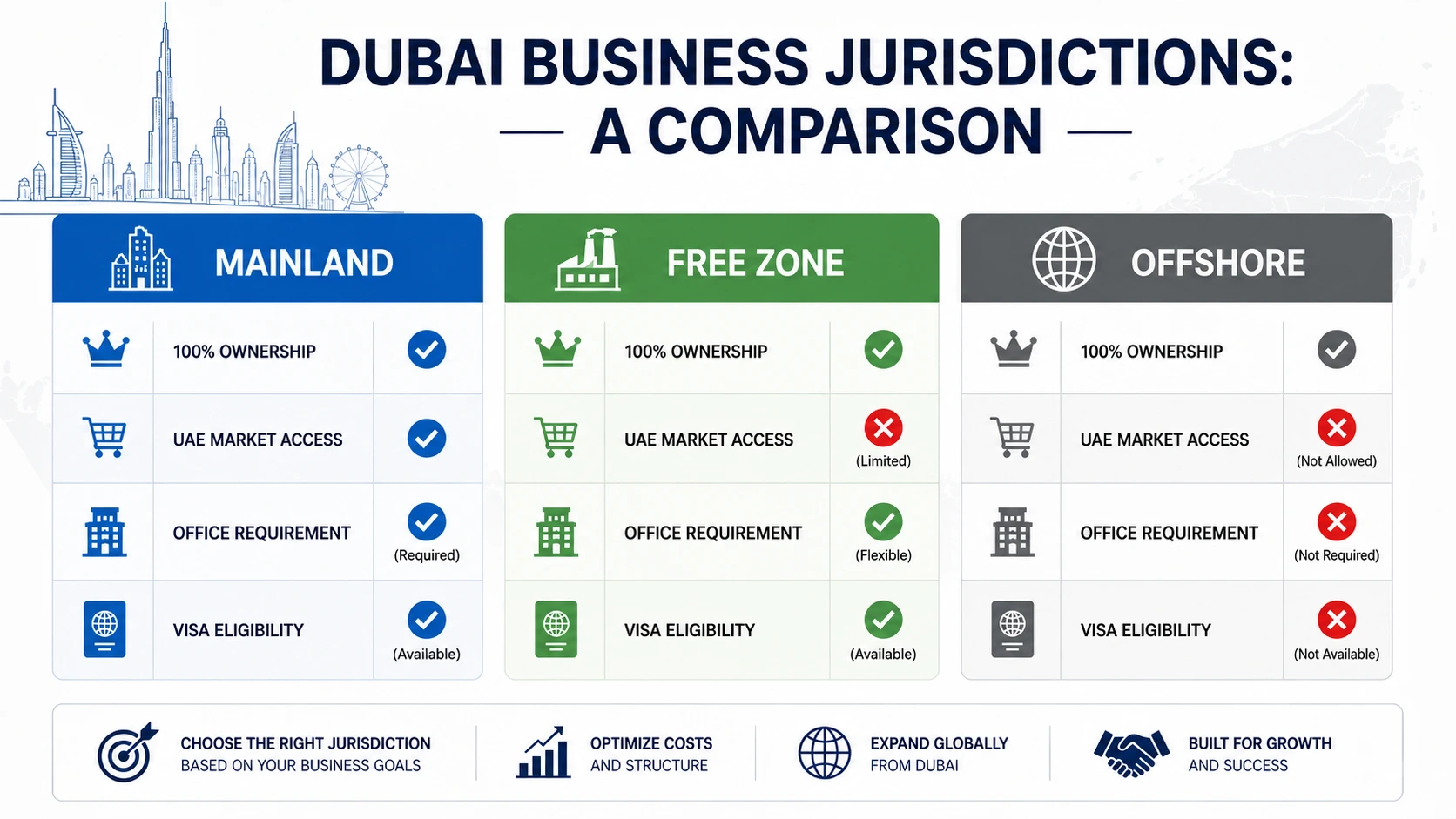
One of the very first and most important decisions you’ll make is choosing where to register your company. Dubai offers three broad jurisdiction types, and each comes with its own rules, benefits, and ideal use cases.
Mainland companies are registered with the Dubai Department of Economy and Tourism (DET) and can trade directly within the UAE local market as well as internationally, without restrictions on where you can do business. Mainland setups are typically the right choice for businesses that need to deal directly with UAE based clients, government entities, or want flexibility to operate from any location across the emirate.
Free Zone companies are established within one of Dubai’s many specialized free zones, each often tailored to a particular industry (media, technology, logistics, finance, and so on). Free zones are popular for their full foreign ownership, simplified setup procedures, and customs benefits but they traditionally come with some restrictions on directly trading within the UAE mainland market without additional arrangements.
Offshore companies are designed primarily for international business activities, asset holding, and tax planning rather than for operating locally within the UAE. They generally cannot lease office space or obtain UAE residency visas, but they offer a straightforward structure for businesses whose operations and clients are based outside the country.
Here’s a side-by-side comparison to help you weigh your options:
| Feature | Mainland | Free Zone | Offshore |
|---|---|---|---|
| Ownership | 100% foreign ownership permitted | 100% foreign ownership | 100% foreign ownership |
| UAE market access | Full access, no restrictions | Limited; often requires a local distributor or branch | Not permitted |
| Office requirement | Physical office generally required | Flexi desk or office options available | No physical office required |
| Visa eligibility | Yes, based on office size | Yes, based on package | Generally not eligible |
| Best suited for | Businesses serving UAE clients directly | Export focused, tech, media, and service businesses | Holding companies, international trading, asset protection |
| Customs benefits | Standard | Duty exemptions on imports/exports within the zone | Not applicable |
There’s no universally “better” option; the right jurisdiction depends entirely on where your customers are, how you plan to operate, and your long-term growth strategy.
Choosing the Right Business Activity for Your Company
Before you can register a company in Dubai, you need to define exactly what your business will do and this decision carries more weight than many first time founders expect.
Your chosen business activity determines which authority regulates your license, what documentation you’ll need, whether additional approvals from other government bodies are required, and even which jurisdictions are available to you. Dubai’s licensing system groups activities into broad categories:
- Commercial activities cover trading, import/export, retail, and general buying and selling of goods.
- Professional activities apply to service-based businesses consultancies, agencies, design studios, and similar ventures where the value is expertise rather than physical goods.
- Industrial activities involve manufacturing, processing, or assembling products, and typically require additional approvals related to facilities and safety.
- E-commerce activities have become their own defined category, reflecting the explosive growth of online retail, and come with their own specific licensing requirements.
Selecting an activity that doesn’t accurately reflect what your business does can create problems down the line; from banking difficulties to compliance issues if regulators later determine your operations don’t match your license. It’s worth taking the time to get this right from day one, ideally with guidance from someone familiar with how Dubai’s licensing authorities classify different types of work.
Step-by-Step Process for New Company Formation in Dubai
While the exact sequence can vary slightly depending on your chosen jurisdiction and activity, new company formation in Dubai generally follows these core steps:
- Select your business activity. As covered above, this shapes nearly every decision that follows, so it comes first.
- Choose your company structure and jurisdiction. Decide between mainland, free zone, or offshore based on your target market, ownership preferences, and operational needs.
- Reserve a trade name. Your company name needs to comply with UAE naming conventions (no offensive or religiously sensitive terms, no reference to government bodies without approval) and must be checked for availability before it can be reserved.
- Obtain initial approvals. This is essentially a green light from the relevant authority confirming there’s no objection to you starting the registration process for your chosen activity.
- Secure office space. Depending on your jurisdiction and license type, this could mean a full commercial office, a flexi-desk, or a co-working arrangement within a free zone.
- Apply for your business license. Once your documentation, approvals, and premises are in order, you submit your formal application for the trade license itself.
- Open a corporate bank account. With your license issued, you can move on to setting up banking a step that has its own set of requirements and, for many entrepreneurs, its own set of challenges (more on that below).
Each of these steps involves its own paperwork, fees, and processing times, which is why many founders choose to work through the process with experienced support rather than navigating it solo.
Documents Required for Company Establishment in Dubai
While requirements vary depending on jurisdiction, business activity, and nationality of shareholders, most company formation applications will require some combination of the following:
- Passport copies of all shareholders, directors, and managers
- Visa and Emirates ID details for any individuals who already hold UAE residency
- A business plan, particularly for activities that require additional regulatory approval or for free zones that request one as part of the application
- Shareholder documentation, such as proof of address, no-objection certificates from current sponsors (for UAE residents), or corporate documents if a shareholder is itself a company
- Office lease agreements, often referred to as an Ejari (for mainland) or the equivalent tenancy contract issued by a free zone authority
- Additional approvals from sector-specific regulators for activities such as healthcare, education, financial services, food and beverage, or media
Having these documents organized and ready before you begin can significantly shorten your overall timeline; incomplete documentation is one of the most common causes of delay during the setup process.
Business License Types Available in Dubai
Your business activity will determine which type of license you need to apply for. The main categories include:
Commercial License: for businesses involved in trading activities, including general trading, import/export, and retail operations.
Professional License: for service providers, consultants, freelancers, and businesses where the core offering is expertise, skills, or professional services rather than physical products.
Industrial License: for companies engaged in manufacturing, production, or industrial processing, often requiring suitable facilities and additional safety or environmental approvals.
Tourism License: for businesses operating in the travel and tourism sector, including tour operators, travel agencies, and related hospitality services, which are regulated separately due to the importance of this sector to Dubai’s economy.
Specialized licenses for emerging sectors: Dubai has increasingly introduced license categories tailored to growth industries, including e-commerce, fintech, crypto and digital assets, healthcare technology, and the creative and media industries, often housed within dedicated free zones built specifically for these sectors.
Choosing the correct license category from the outset avoids the need for costly amendments later and ensures your operations remain fully compliant as your business grows or evolves.
How Much Does Company Establishment in Dubai Cost in 2026?
This is, understandably, one of the most common questions entrepreneurs ask and one of the hardest to answer with a single number, because company establishment in Dubai costs depend heavily on your jurisdiction, business activity, office requirements, and number of visas needed.
That said, here’s a general breakdown of the cost components you should budget for:
| Cost Component | What It Covers | Notes |
|---|---|---|
| Trade license fee | Annual fee for the business license itself | Varies by activity and authority |
| Initial approval & registration fees | Name reservation, initial approval, and registration with the relevant authority | Generally one-time costs |
| Office/facility costs | Flexi-desk, co-working space, or full office lease | Free zones often offer lower-cost flexi-desk options |
| Visa costs | Entry permit, status change, medical test, Emirates ID, and visa stamping per person | Multiplies with each employee/shareholder visa |
| Government and notarization fees | Memorandum of Association (MOA) drafting, notarization, and Chamber of Commerce registration (for mainland) | Mainly relevant to mainland setups |
| Additional regulatory approvals | Sector-specific approvals (e.g., health authority, financial regulator) | Only applies to regulated activities |
| Bank account setup | Generally no direct government fee, but banks may require minimum balances | Varies significantly by bank |
Hidden expenses worth planning for include renewal fees (licenses and visas typically need annual renewal, sometimes with fee increases), amendment fees if you later change your activity, shareholders, or office address, and the cost of mandatory insurances depending on your industry. Many entrepreneurs also underestimate ongoing accounting, auditing, and PRO (Public Relations Officer) service costs, which become recurring operational expenses rather than one-time setup costs.
Because pricing structures change and vary so much by free zone and activity, getting a tailored quote from a licensed business setup consultant is the most reliable way to understand your real total cost before committing.
Common Challenges Entrepreneurs Face During Business Setup
Even with Dubai’s relatively streamlined processes, founders particularly those setting up a company for the first time or doing so from abroad often run into a handful of recurring obstacles.
Choosing the wrong jurisdiction is perhaps the most consequential mistake, since it’s not always simple (or cheap) to change later. A business that picks a free zone for its lower setup cost, only to discover it needs significant mainland UAE clients, may find itself needing a costly restructure down the line.
Documentation errors, missing attestations, incorrect translations, or mismatched information across documents are a frequent cause of application delays or rejections, especially for shareholders applying from outside the UAE.
Delays in approvals can occur when an activity requires sign-off from multiple government departments, particularly for regulated sectors, and timelines aren’t always predictable.
Banking challenges have become increasingly common as UAE banks apply stricter due diligence (know-your-customer) requirements. New companies especially those with no UAE operating history can sometimes face lengthy account opening processes or, in some cases, rejections that require reapplying with a different bank.
Compliance misunderstandings around ongoing obligations such as VAT registration thresholds, economic substance regulations, or annual audit requirements can catch new business owners off guard if they assume that “setting up” the company is the end of the regulatory journey rather than the beginning.
Being aware of these pitfalls ahead of time and planning around them is one of the simplest ways to avoid costly delays.
Why Many Investors Choose Professional Company Formation Services in Dubai
Given the number of moving parts involved jurisdiction selection, activity classification, documentation, approvals, and banking it’s no surprise that a large share of entrepreneurs choose to work with company formation services in Dubai rather than handling everything independently.
Faster setup. Professionals who handle these applications daily know exactly what each authority expects, which means fewer back-and-forth requests and fewer delays caused by avoidable errors.
Expert guidance on legal requirements. Regulations differ across mainland, free zones, and specific industries and they evolve. A knowledgeable consultant keeps track of these changes so you don’t have to.
Documentation assistance. From preparing your Memorandum of Association to ensuring every shareholder document is correctly attested and translated, formation specialists handle the administrative load that often trips up first time founders.
Visa and licensing support. Beyond the company license itself, formation services typically coordinate the visa application process for owners, employees, and dependents managing medical tests, Emirates ID applications, and status changes.
Ongoing compliance management. Many providers don’t disappear once your license is issued, they continue supporting renewals, amendments, VAT registration, and other compliance needs as your business grows.
For entrepreneurs juggling the demands of building a business, having a knowledgeable partner manage the regulatory side can be the difference between a smooth launch and months of avoidable friction.
How Business Setup Services in Dubai Simplify the Process
Beyond the initial registration, business setup services in Dubai typically offer end-to-end support that extends well into your company’s first months and years of operation.
End-to-end business setup support means a single point of contact manages your journey from initial consultation through to license issuance; coordinating between government departments, free zone authorities, and other stakeholders on your behalf.
Trade license assistance covers everything from activity selection and name reservation through to the final license application and renewal reminders, so you’re never caught off guard by an expiry date.
PRO services (Public Relations Officer services) handle the government liaison work that can otherwise consume hours of an entrepreneur’s time submitting documents, following up on approvals, and managing the paperwork involved in visa processes.
Corporate banking assistance can be invaluable given the due diligence challenges mentioned earlier. Established setup providers often have relationships with multiple banks and a clear understanding of what each institution requires, helping match your business profile to the right banking partner.
Visa processing and renewals for owners, staff, and family members are typically managed as part of the package, including the medical testing, Emirates ID issuance, and status adjustments involved.
Post-incorporation support including accounting, bookkeeping, VAT registration, and annual compliance filings ensures that the work doesn’t stop once your license is in hand, helping your business stay compliant as regulations evolve.
In short, the right setup partner doesn’t just get your company registered they help build the operational foundation your business needs to function and grow in the UAE market.
Frequently Asked Questions About Company Formation in Dubai
How long does new company formation in Dubai take?
Timelines vary depending on jurisdiction and business activity. Straightforward free zone setups with all documentation ready can sometimes be completed within a matter of days, while mainland setups involving multiple approvals, office leasing, and visa processing typically take longer. Working with an experienced consultant and having complete documentation upfront are the biggest factors in keeping timelines short. We can help you form the Company from the comfort of your home sitting in your Country by just uploading a few basic documents.
Which is better: Mainland or Free Zone company setup?
Neither option is universally “better”; it depends on your business model. If you need to trade directly with UAE-based clients across any location in the emirate, mainland is usually the right fit. If your business is export-focused, service-based for international clients, or you value the streamlined setup and customs benefits of a specific industry cluster, a free zone may suit you better.
Do I need a physical office to register a company in Dubai?
In most cases, yes. Some form of registered business address is required, though this doesn’t always mean a large commercial office. Many free zones offer flexi-desk or shared workspace packages that satisfy this requirement at a lower cost, while mainland companies generally need a leased office space with a registered Ejari (meaning a registered contract of tenancy).
What are the benefits of using company formation services in Dubai?
Beyond saving time, professional formation services help you avoid costly jurisdiction or activity mistakes, ensure your documentation is correctly prepared and attested, support you through the often-challenging bank account opening process, and provide ongoing compliance support, letting you focus on running your business rather than navigating bureaucracy.
Start Your Dubai Business Journey with Confidence
Setting up a company in Dubai in 2026 involves a clear sequence of decisions choosing the right jurisdiction, defining your business activity accurately, gathering the correct documentation, selecting the appropriate license, and budgeting realistically for both setup and ongoing costs. Each step builds on the last and getting the early decisions right makes everything that follows considerably easier.
While it’s entirely possible to navigate this process independently, the entrepreneurs who move fastest and avoid the most common pitfalls are usually the ones who bring in experienced guidance from the start. From jurisdiction selection through to banking, visas, and post incorporation compliance, the right partner turns a complex regulatory process into a manageable, predictable journey.
Dubai’s business friendly environment, global connectivity, and forward-looking economic policies make it one of the most compelling places in the world to launch or expand a business right now. If you’re ready to take the next step, reach out to our team of company formation experts today at PrudentDubai.com for a personalized consultation and let us help turn your Dubai business plans into reality.